
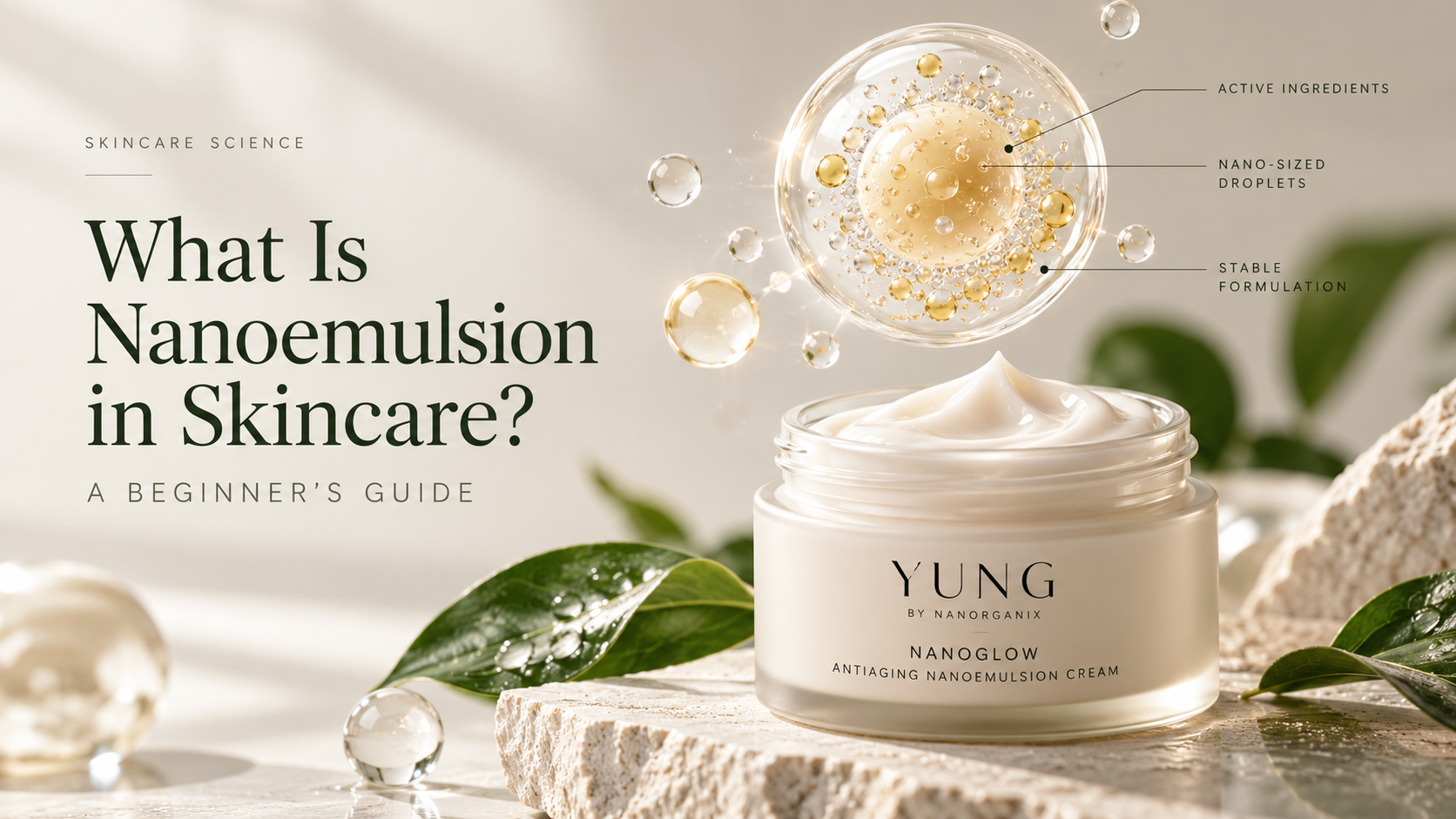
Skincare is about more than the ingredients listed on a product label. How those ingredients are combined and formulated also matters. One term appearing in modern skincare is nanoemulsion—a formulation approach that researchers have been exploring for its potential applications in cosmetic products.
But what does nanoemulsion actually mean? How does it differ from a conventional emulsion, and what should you know before choosing a skincare product that uses this technology?
Let’s explore the basics.
What Is a Nanoemulsion?
A nanoemulsion is a mixture of two liquids that do not naturally mix well, such as oil and water, formulated so that one liquid is dispersed as very small droplets throughout the other. These droplets are stabilized using suitable ingredients known as emulsifiers or stabilizing agents.
The term nano refers to the very small scale of the dispersed droplets. Nanoemulsions are studied in several fields, including pharmaceutical and cosmetic formulation, because droplet size and composition can influence the properties of a finished product.
However, nanoemulsions are not all the same. Their characteristics depend on the ingredients, preparation method, droplet size, and overall formulation.
Why Is Nanoemulsion Technology Used in Skincare?
Some cosmetic ingredients do not mix easily with water. Others can be sensitive to environmental conditions or may be difficult to incorporate into a stable formulation.
Nanoemulsion technology is being studied as one way to address some of these formulation challenges.
1. Helping combine oil- and water-based ingredients
Oil and water naturally separate when mixed without suitable formulation support. An emulsion helps bring them together into a more uniform product.
Nanoemulsions use very small dispersed droplets, which can influence how the formulation behaves. The final result depends on the particular ingredients and how the product is developed.
2. Supporting formulation stability
Keeping a skincare product consistent over time is an important part of product development. Researchers investigate nanoemulsions for their potential to improve the physical stability of certain formulations.
That does not mean every nanoemulsion is automatically stable. Formulators must evaluate the finished product to understand how it performs during storage and use.
3. Influencing the delivery of selected ingredients
The way an ingredient is incorporated into a formulation can influence its availability and interaction with the skin.
Research into nanoemulsions explores how small droplets and formulation components may affect the delivery of selected ingredients. The results depend on the specific system being studied, so benefits should not be assumed for every product using the term.
Nanoemulsion vs. Conventional Emulsion: What’s the Difference?
Both conventional emulsions and nanoemulsions combine liquids that would otherwise tend to separate. The main distinction is the size of the dispersed droplets and the resulting properties of the formulation.
A conventional emulsion may be used in creams, lotions, and other familiar skincare products. Nanoemulsions are designed around much smaller droplets and may behave differently depending on their composition.
Neither approach is automatically better in every situation. A well-designed skincare product depends on its intended purpose, ingredients, stability, safety, and performance—not simply on the technology named on its label.
Does Nanoemulsion Mean Better Skincare Results?
Not necessarily.
A product’s performance depends on much more than its formulation method. The ingredients it contains, their concentrations, the quality of the finished formulation, and the evidence supporting its intended use all matter.
The word nanoemulsion alone does not prove that a product will reduce wrinkles, improve hydration, or deliver ingredients more effectively in real-world use.
When evaluating skincare, look beyond the terminology. Consider the complete ingredient list, the product’s directions, the manufacturer’s supporting information, and any relevant testing or evidence available.
What Should You Look for When Choosing a Skincare Product?
If you’re considering a product described as a nanoemulsion, keep these practical points in mind.
Understand the ingredients. Read the ingredient list and learn about the role of the ingredients that matter to your skincare needs.
Look for clear product information. A reputable product should provide understandable directions, appropriate warnings, and information about its intended use.
Consider your skin’s needs. Skin can respond differently to the same product. Introduce new skincare thoughtfully and discontinue use if irritation occurs.
Follow the directions. Use the product as instructed rather than assuming that a particular formulation technology means it can be used more frequently or in larger amounts.
Be realistic about results. Avoid choosing a product solely because it uses a scientific-sounding term. Look for credible evidence supporting the specific benefits being claimed.
Where Does NanoGlow Fit In?
At YUNG by Nanorganix, our skincare offering includes NanoGlow Antiaging Nanoemulsion Cream.
The product is part of our focus on bringing formulation science and thoughtful skincare into an everyday ritual. As with any skincare product, we encourage customers to understand its ingredients, follow its directions, and choose products suited to their individual needs.
If you’re exploring nanoemulsion skincare, NanoGlow is an opportunity to learn more about the product and how it fits into your routine.
Discover NanoGlow Antiaging Nanoemulsion Cream
A More Considered Approach to Skincare
Nanoemulsion technology is an interesting area of cosmetic formulation research, particularly for the challenges involved in combining ingredients and developing stable products.
But the technology is only one part of the picture. A thoughtful skincare choice considers the complete formulation, the evidence behind its claims, and how the product fits into your own routine.
Understanding the science can help you ask better questions, read product information more carefully, and make more informed choices about your skin.
This article is for general educational purposes and is not a substitute for professional dermatological advice.